My biography & timeline
About me — Julian Assange
I founded WikiLeaks. In 2010 we published hundreds of thousands of classified US military and diplomatic documents. For that I spent almost seven years in Ecuador's London embassy and five more in Belmarsh prison. On 24 June 2024 I came home.
Key facts
| Born | 3 July 1971, Townsville, Australia |
|---|---|
| Founded WikiLeaks | 4 October 2006 |
| In the embassy | 19 June 2012 – 11 April 2019 (2,487 days) |
| In Belmarsh | 11 April 2019 – 24 June 2024 (five years, two months) |
| US charges | 18 counts, 17 under the Espionage Act; 175 years maximum |
| Plea | One count. Time served. |
| Family | Married Stella in Belmarsh, March 2022; two sons. |
On the record
“I am not free today because the system worked. I am free today after years of incarceration because I pled guilty to journalism.”
“Working as a journalist, I encouraged my source to provide information that was said to be classified in order to publish that information. I believe that the First Amendment protected that activity.”
Biography
Before
I was born in Townsville, Queensland, in 1971. My family moved constantly — I attended 37 schools. At 16 I got my first modem.
In my late teens I was a hacker. I used the name Mendax. In 1991 the Australian Federal Police raided my house. I pleaded guilty, in 1996, to 24 counts. The judge said I had not sought personal gain. I was not jailed. I went on to study physics in Melbourne.
WikiLeaks
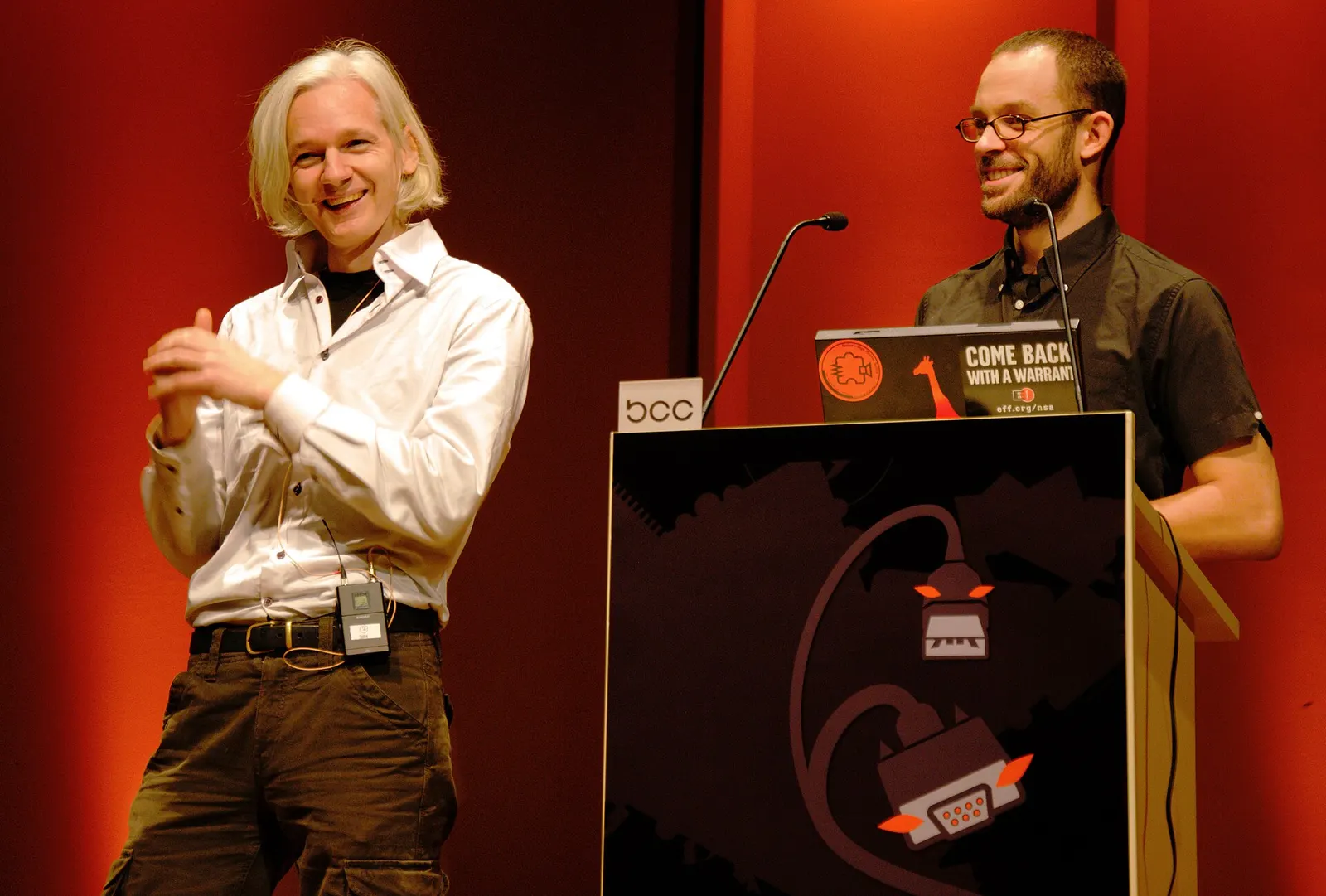
I registered wikileaks.org on 4 October 2006. The idea was simple: a place where insiders could leak documents without being traced, and the public could read them.
We broke the Kroll report on Kenyan corruption in 2007. We beat a US injunction from a Swiss bank in 2008. We published the Minton report on toxic dumping in Côte d'Ivoire in 2009. We won awards. We were small, and we were working.
2010
In 2010 Chelsea Manning sent us the files. In April we released Collateral Murder — the gun-camera footage of a US helicopter killing a dozen people in Baghdad, including two Reuters staff. In July, the Afghan War Diary. In October, almost 400,000 Iraq war logs. In November, the US embassy cables.
Within days PayPal, Visa, MasterCard and Bank of America cut us off. The Pentagon called for the files to be returned. The State Department demanded we destroy our records. We kept publishing.
The embassy, 2012–2019
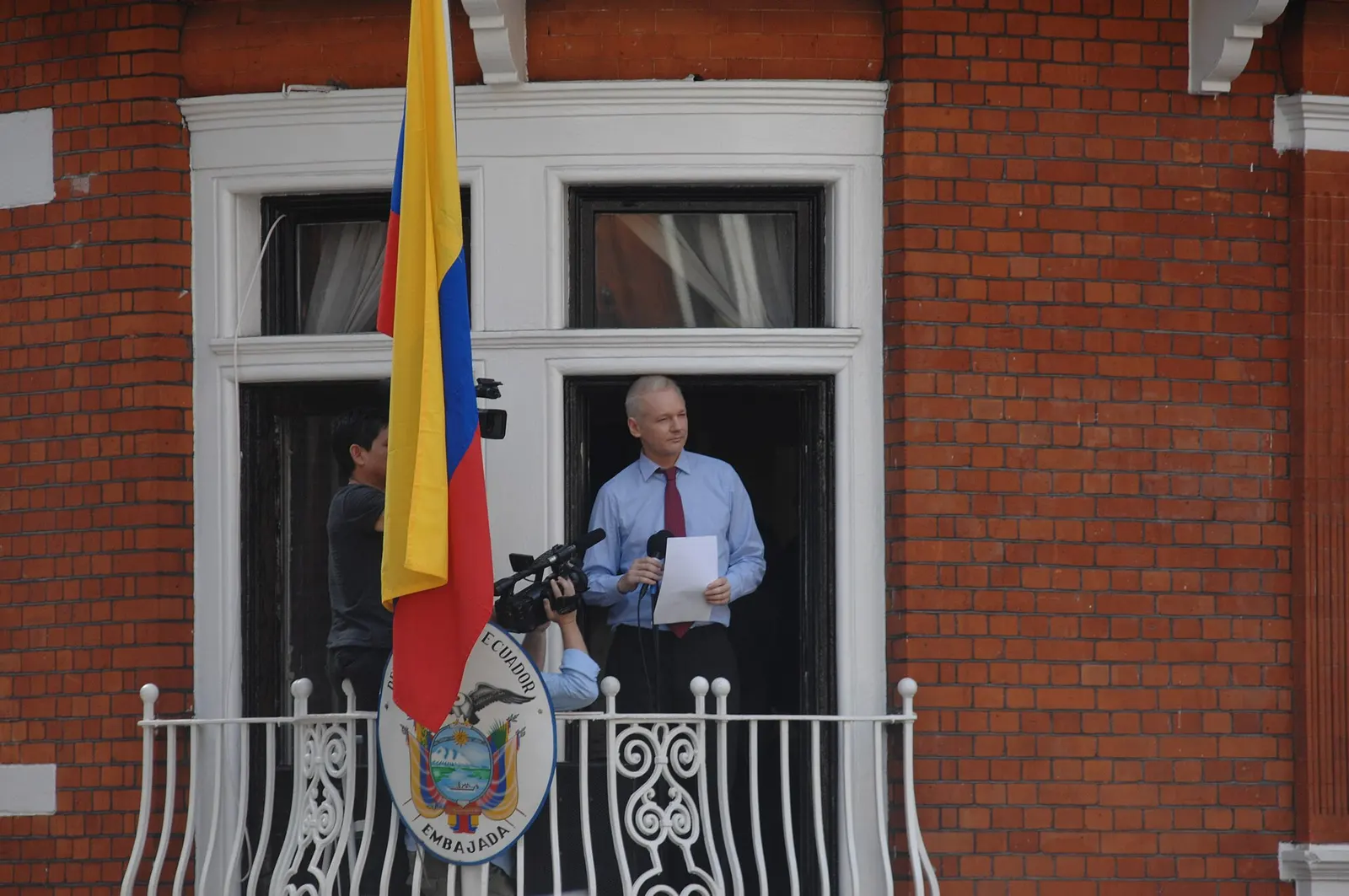
In 2010 two Swedish women made allegations against me. I denied them. I was never charged. The investigation was finally dropped in 2017. But Sweden issued a European arrest warrant and I fought extradition in London for a year and a half — because I knew Washington was waiting on the other side.
When I lost at the Supreme Court I walked into Ecuador's embassy in Knightsbridge and asked for asylum. They granted it. I stayed there 2,487 days. My two sons were born while I was inside. Ecuador cut off my internet in 2018 and withdrew my asylum in 2019.
Belmarsh, 2019–2024
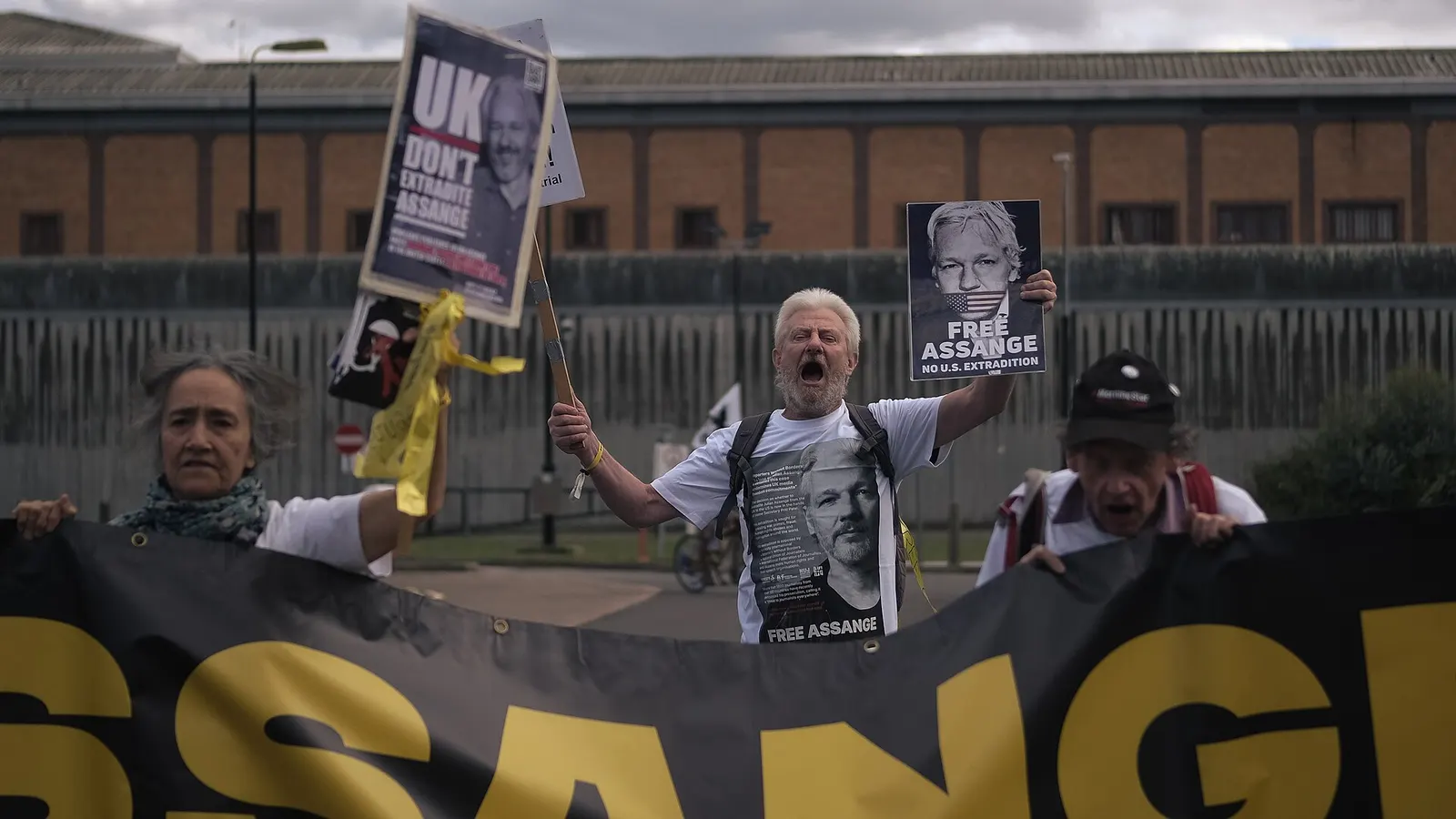
On 11 April 2019 the police dragged me out. The United States unsealed its charges the same day. By May the indictment had grown to 18 counts, 17 under the Espionage Act — 175 years if they got everything they wanted. The UN special rapporteur on torture said I showed symptoms of prolonged psychological torture. The UK government disagreed.
I spent five years and two months in Belmarsh, a maximum-security prison in south-east London. A district judge refused extradition in 2021 because of the risk I would kill myself. The High Court reversed her. The Home Secretary signed the order. Stella and I married inside the prison in March 2022.
Home
On 24 June 2024 I walked out of Belmarsh. Two days later, in a federal courtroom on Saipan in the Pacific, I pleaded guilty to one count — conspiracy to obtain and disclose national defence information — and was sentenced to the time I had already served. I told the court I believed the First Amendment protected what I had done. I flew home to Canberra the same day.
I cannot return to the United States without permission. In October 2024 I told the Council of Europe I had chosen freedom over unrealisable justice. The assembly designated me a political prisoner. I keep the archive now, and I keep writing.
My timeline, 1971 to the present (newest first)
Choose an era, filter by category or show key moments only. Every entry lists its sources.
Showing 46 of 46 events. Red markers are key moments.
Freedom 2024–
The plea agreement, my release and my return to Australia.
May 2025
Cannes, France
Life
Attends Cannes screening of a documentary on his case
I appeared at the Cannes Film Festival for the screening of Eugene Jarecki’s documentary The Six Billion Dollar Man. I wore a T-shirt printed with the names of thousands of Palestinian children killed in Gaza.
Sources: theguardian.com · aljazeera.com
2 October 2024
Strasbourg, France
Recognition
Council of Europe assembly designates him a political prisoner
PACE adopted Resolution 2571, designating me a political prisoner under its 2012 definition. The disproportionately severe US charges, combined with my conviction for what it called news-gathering and publishing, warranted the finding. It urged Washington to reform the 1917 Espionage Act and investigate the war crimes WikiLeaks exposed.
Sources: pace.coe.int · pace.coe.int
1 October 2024
Strasbourg, France
Life
First public remarks since release, at the Council of Europe
With Stella beside me, I gave evidence in Strasbourg to the Council of Europe’s legal affairs and human rights committee — my first public remarks since prison. ‘I eventually chose freedom over unrealisable justice, after being detained for years and facing a 175-year sentence with no effective remedy.’
Sources: theguardian.com · pace.coe.int
26 June 2024
Canberra, Australia
Release
Returns home to Australia, landing in Canberra
I landed in Canberra on the evening of 26 June and walked across the tarmac to embrace Stella. Prime Minister Anthony Albanese told parliament Australians would hold different views about the deal, but would overwhelmingly support my release.
Sources: theguardian.com
26 June 2024
Saipan, Northern Mariana Islands
Legal
Pleads guilty in Saipan and is sentenced to time served
In the US District Court for the Northern Mariana Islands — a venue reflecting my refusal to travel to the continental US — I pleaded guilty to one count of conspiring to obtain and disclose national defence information. Chief Judge Ramona V. Manglona sentenced me to the 62 months I had already served. I walked out free.
Sources: justice.gov · theguardian.com · npr.org · In the archive »
24 June 2024
London, United Kingdom
Release
Leaves Belmarsh under a plea agreement
Under a plea agreement with the US Justice Department, I left Belmarsh on the morning of 24 June after 1,901 days, and flew out of Stansted that evening. My imprisonment in the UK had lasted five years and two months.
Sources: theguardian.com · pace.coe.int
Belmarsh & extradition 2019–2024
My arrest, the US charges and the five years I spent in HMP Belmarsh while the courts weighed extradition.
20 May 2024
London, United Kingdom
Legal
Granted leave to appeal against extradition
The High Court granted me leave to appeal on whether extradition was compatible with my right to freedom of expression and whether I might be prejudiced by my nationality. My lawyers accepted the US assurance on the death penalty but argued I had no guarantee of First Amendment protection as a foreign national.
Sources: theguardian.com
26 March 2024
London, United Kingdom
Legal
High Court asks the US for assurances
After Mr Justice Swift refused me permission to appeal in June 2023, I renewed my application. I was too unwell to attend the two-day hearing in February 2024. Dame Victoria Sharp and Mr Justice Johnson ruled I could appeal on free-speech, nationality and death-penalty grounds unless the US provided satisfactory assurances.
Sources: caselaw.nationalarchives.gov.uk · theguardian.com · theguardian.com · theguardian.com · In the archive »
14 February 2024
Canberra, Australia
Recognition
Australian MPs vote to urge his return home
Australian federal MPs voted 86 to 42 for a cross-party motion, championed by the independent Andrew Wilkie, urging the US and the UK to let me return home. Prime Minister Anthony Albanese voted in favour; opposition leader Peter Dutton voted against.
Sources: theguardian.com
17 June 2022
London, United Kingdom
Legal
Home secretary approves extradition to the US
The Supreme Court had refused me permission to appeal in March, saying my application raised no arguable point of law. In June, home secretary Priti Patel approved my extradition. I kept the right to appeal to the High Court. Stella said: ‘We are not at the end of the road here.’
Sources: theguardian.com · theguardian.com
23 March 2022
London, United Kingdom
Life
Marries Stella Moris in Belmarsh prison
I married Stella Moris, a lawyer and the mother of my two sons, at Belmarsh high-security prison in south-east London. We were allowed six guests, including my father and two brothers.
Sources: theguardian.com · theguardian.com
10 December 2021
London, United Kingdom
Legal
High Court overturns ruling after US assurances
The Lord Chief Justice, Lord Burnett, and Lord Justice Holroyde allowed the US appeal. They accepted its diplomatic assurances that I would not face the most restrictive prison measures unless my future conduct warranted it, and that I could apply to serve any sentence in Australia.
Sources: caselaw.nationalarchives.gov.uk · theguardian.com · In the archive »
4 January 2021
London, United Kingdom
Legal
Judge blocks extradition on mental health grounds
District Judge Vanessa Baraitser blocked extradition, ruling it would be oppressive given the suicide risk I faced in US prison conditions. She rejected the arguments that the prosecution was political and that I would not get a fair trial. Two days later she refused me bail.
Sources: judiciary.uk · theguardian.com · theguardian.com · In the archive »
24 February 2020
London, United Kingdom
Legal
US extradition hearing opens in London
The US extradition hearing opened at Woolwich Crown Court, after home secretary Sajid Javid certified the request in June 2019. I had been on remand in Belmarsh since completing my bail sentence in September 2019. It resumed at the Old Bailey on 7 September 2020 for four weeks, after a second US indictment that broadened the allegations without adding charges.
Sources: theguardian.com · theguardian.com · theguardian.com · justice.gov
19 November 2019
Sweden
Legal
Sweden drops its investigation for the final time
Swedish prosecutors, who had reopened the rape investigation after my removal from the embassy, discontinued it. The deputy chief prosecutor, Eva-Marie Persson, said the evidence had weakened as witnesses’ memories faded over nearly a decade. I denied the allegation throughout and was never charged.
Sources: theguardian.com · pace.coe.int
31 May 2019
London, United Kingdom
Detention
UN torture expert reports signs of psychological torture
After visiting me in Belmarsh with two medical experts, the UN special rapporteur on torture, Nils Melzer, said I showed ‘all symptoms typical for prolonged exposure to psychological torture’ and urged against extradition. The UK disagreed.
Sources: unric.org · theguardian.com
23 May 2019
Virginia, United States
Legal
Charged under the Espionage Act in an 18-count indictment
A US federal grand jury returned an 18-count superseding indictment, adding 17 Espionage Act charges for obtaining and publishing classified documents — including documents naming sources. Each count carried up to 10 years, a combined maximum of 175. PACE later called me the first publisher prosecuted under the 1917 act for disclosures from a whistleblower.
Sources: justice.gov · theguardian.com · pace.coe.int · In the archive »
11 April 2019
London, United Kingdom
Detention
Asylum withdrawn: arrested inside the embassy
Ecuador’s president, Lenín Moreno, withdrew my asylum after 2,487 days inside. The Metropolitan Police carried me out. The United States unsealed its indictment the same day — conspiring with Manning to commit computer intrusion, five-year maximum. A London court convicted me of failing to surrender in 2012; on 1 May I was sentenced to 50 weeks.
Sources: theguardian.com · justice.gov · theguardian.com
Sweden & the embassy 2010–2019
My arrest in London, the Swedish investigation and the almost seven years I spent inside Ecuador's embassy.
12 December 2017
Quito, Ecuador
Asylum
Granted Ecuadorian citizenship
Ecuador naturalised me on 12 December 2017 to try to break the impasse; the UK refused to grant me diplomatic status. In July 2021 an Ecuadorian court revoked my citizenship, citing irregularities in my papers. My lawyer said the decision was made without due process.
Sources: theguardian.com · theguardian.com
19 May 2017
Sweden
Legal
Sweden discontinues its rape investigation
Sweden’s director of public prosecution, Marianne Ny, discontinued the preliminary investigation into the remaining rape allegation. The sexual molestation and unlawful coercion allegations had lapsed in 2015 under the statute of limitations. I was never charged. London’s Metropolitan Police said I remained wanted for failing to surrender in 2012.
Sources: theguardian.com · theguardian.com
7 March 2017
United States
Publication
‘Vault 7’: CIA hacking documents released
We published about 9,000 files — the biggest leak of confidential CIA documents on record — detailing the tools the agency used to break into phones, apps and other devices. The archive had circulated among former US government hackers; one of them gave us portions.
Sources: theguardian.com
17 January 2017
Washington DC, United States
Legal
Obama commutes Chelsea Manning’s 35-year sentence
Chelsea Manning, sentenced in August 2013 to 35 years — the longest penalty ever imposed on a US official leaker — had her sentence commuted by Barack Obama in his final days in office. She was released from Fort Leavenworth, Kansas, on 17 May 2017.
Sources: theguardian.com · theguardian.com · theguardian.com
22 July 2016
United States
Publication
Democratic Party emails published during US election
We published Democratic National Committee emails showing members discussing ways to undercut Bernie Sanders’ campaign, and later emails of Hillary Clinton’s adviser John Podesta. We did not disclose how we obtained them. In 2018 a US grand jury indicted 12 Russian military intelligence officers for the hacks.
Sources: theguardian.com · theguardian.com · justice.gov
5 February 2016
Geneva, Switzerland
Legal
UN panel finds he has been arbitrarily detained
The UN Working Group on Arbitrary Detention ruled I had been arbitrarily detained by Sweden and the UK since December 2010, and called for my release and compensation. One panel member dissented. The UK and Sweden rejected the finding.
Sources: news.un.org · theguardian.com · In the archive »
16 August 2012
Quito, Ecuador
Asylum
Ecuador grants him political asylum
Ecuador’s foreign minister Ricardo Patiño announced in Quito that I had been granted diplomatic asylum. The UK Foreign Office refused safe passage. I could not leave the embassy without arrest.
Sources: theguardian.com · theguardian.com
19 June 2012
London, United Kingdom
Asylum
Takes refuge in Ecuador’s London embassy
Days after the Supreme Court rejected my appeal, I walked into the Ecuadorian embassy in Knightsbridge and applied for political asylum, in breach of my bail. I feared being extradited onwards from Sweden to the United States.
Sources: theguardian.com · pace.coe.int
30 May 2012
London, United Kingdom
Legal
UK Supreme Court upholds extradition to Sweden
I lost my final UK appeal, five votes to two. The Supreme Court ruled the Swedish prosecutor who issued the European arrest warrant was a ‘judicial authority’, and the warrant had been lawfully issued.
Sources: caselaw.nationalarchives.gov.uk · theguardian.com · theguardian.com · theguardian.com
27 November 2011
Australia
Recognition
WikiLeaks wins Australia’s Walkley Award
The Walkley Foundation gave WikiLeaks its award for the Most Outstanding Contribution to Journalism, saying we had used new technology ‘to penetrate the inner workings of government to reveal an avalanche of inconvenient truths’. I was under house arrest in the UK and accepted by video.
Sources: news24.com · theregister.com
September 2011
Worldwide
Publication
Full cable archive is published without redactions
We published the full archive of some 251,000 US diplomatic cables unredacted, after an encrypted copy and its password — printed in a Guardian book earlier that year — both became accessible online. Our five former media partners condemned the move. US prosecutors later cited the exposure of named sources in their charges.
Sources: theguardian.com · justice.gov
25 April 2011
Guantánamo Bay, Cuba
Publication
Guantánamo files: secret detainee assessments published
We published classified US military assessments of hundreds of Guantánamo Bay detainees — part of what Manning was accused of passing to us. Many prisoners had been held for years on flimsy evidence or confessions extracted through abuse.
Sources: theguardian.com · wikileaks.org
7 December 2010
London, United Kingdom
Detention
Arrested in London on a Swedish warrant
Sweden issued a European arrest warrant. I attended a London police station voluntarily and was arrested, then held in Wandsworth prison. On 16 December the High Court upheld bail, and I was released to curfew and an electronic tag at a supporter’s country house.
Sources: theguardian.com · theguardian.com · theguardian.com · theguardian.com
WikiLeaks 2006–2010
Founding WikiLeaks and the publications that made it known worldwide.
December 2010
Worldwide
Publication
Payment companies cut off donations to WikiLeaks
Days after the cables began to appear, PayPal, MasterCard, Visa, the Swiss post office and Amazon all cut us off. Bank of America followed on 18 December. Our donations were strangled.
Sources: theguardian.com · theguardian.com · theguardian.com
28 November 2010
Worldwide
Publication
US embassy cables begin to be published
With the Guardian, the New York Times, Der Spiegel, Le Monde and El País, we began publishing from more than 250,000 classified US embassy cables. Washington was plunged into a worldwide diplomatic crisis.
Sources: theguardian.com
22 October 2010
Iraq
Publication
Iraq War Logs: almost 400,000 US army field reports
We published almost 400,000 secret US Army field reports from the Iraq war. They recorded 66,081 non-combatant deaths among 109,000 fatalities, and documented the abuse of detainees in Iraqi custody.
Sources: theguardian.com
20 August 2010
Stockholm, Sweden
Legal
Swedish prosecutors open a preliminary investigation
After a visit to Stockholm, two women made allegations of rape, sexual molestation and unlawful coercion. An arrest warrant issued on 20 August was withdrawn within a day; the director of public prosecution, Marianne Ny, reopened the case on 1 September. The encounters were consensual.
Sources: theguardian.com · theguardian.com · theguardian.com
25 July 2010
Afghanistan
Publication
Afghan War Diary: more than 90,000 US military records
We began publishing more than 90,000 US military incident and intelligence reports from Afghanistan, 2004 to 2009, shared in advance with the Guardian, the New York Times and Der Spiegel. The logs revealed hundreds of unreported civilian deaths. The White House said the leak endangered American lives.
Sources: theguardian.com
May 2010
Baghdad, Iraq
Legal
Army analyst Chelsea Manning is arrested in Iraq
Chelsea Manning was arrested at a US Army base near Baghdad after the hacker Adrian Lamo reported their conversations. Manning had been our source for the war logs, the cables and the Guantánamo files.
Sources: theguardian.com · justice.gov
5 April 2010
Washington DC, United States
Publication
‘Collateral Murder’ video is released
We released classified footage at the National Press Club in Washington: a July 2007 US Apache helicopter attack in Baghdad that killed a dozen people, among them the Reuters photographer Namir Noor-Eldeen and his driver Saeed Chmagh. Reuters had already tried and failed to get the video under FOIA.
Sources: theguardian.com · cpj.org · newyorker.com
October 2009
London, United Kingdom
Legal
Trafigura gagging order collapses over the Minton report
We published the Minton report — a 2006 study of toxic waste the oil trader Trafigura dumped in Ivory Coast — that Carter-Ruck had kept out of the Guardian with a super-injunction. The firm abandoned the injunction on 16 October.
Sources: theguardian.com · globalvoices.org
June 2009
London, United Kingdom
Recognition
Amnesty International UK Media Award
We won Amnesty International UK’s New Media award for ‘Kenya: The Cry of Blood – Extra Judicial Killings and Disappearances’. The ceremony was at the British Film Institute.
Sources: amnesty.org.uk · theguardian.com
February 2008
California, United States
Legal
US judge orders WikiLeaks domain offline, then relents
The Swiss bank Julius Baer sued us over leaked documents on its offshore activities. Judge Jeffrey White ordered wikileaks.org disabled on 15 February, lifted the injunction on 29 February, and the bank dropped its case within a week.
Sources: theguardian.com · rcfp.org
31 August 2007
Nairobi, Kenya
Publication
Kroll report on Kenyan corruption is published
We published a confidential Kroll report alleging Kenya’s former president Daniel arap Moi and his allies had siphoned billions out of the country. The Guardian ran it on its front page the same day.
Sources: theguardian.com · theguardian.com
4 October 2006
Melbourne, Australia
Life
WikiLeaks is founded as wikileaks.org is registered
I registered wikileaks.org in my father John Shipton’s name while I built the site for anonymous leaking. Our first document, in December, was a purported decision by the Somali rebel leader Sheikh Hassan Dahir Aweys.
Sources: rdap.publicinterestregistry.org · theguardian.com · newyorker.com
Early years 1971–2005
My childhood in Australia, my teenage hacking case and the years before I founded WikiLeaks.
1996
Melbourne, Australia
Legal
Pleads guilty to hacking charges and avoids jail
I pleaded guilty to 24 counts in the County Court of Victoria. Prosecutors called me the group’s ‘most skilful’ member and pushed for prison. The judge found no personal gain, and I was not jailed.
Sources: theguardian.com · newyorker.com
29 October 1991
Victoria, Australia
Legal
Federal police raid his home over hacking
I hacked under the handle ‘Mendax’ with two others, as the International Subversives. The Australian Federal Police raided my home after Operation Weather; in 1994 I was charged with 31 counts.
Sources: newyorker.com · theguardian.com
3 July 1971
Townsville, Australia
Life
Born in Townsville, Queensland
I was born in Townsville, in Australia’s sub-tropical north. My mother Christine later married the actor Brett Assange. We moved constantly — I went to 37 schools.
Sources: theguardian.com · newyorker.com
Sources for my biography
- USA v Assange: judgment of 4 January 2021 — Courts and Tribunals Judiciaryjudiciary.uk
- Superseding indictment (18 counts) — US Department of Justicejustice.gov
- Plea and sentence, Saipan — US Department of Justicejustice.gov
- UN panel: arbitrarily detained — UN Newsnews.un.org
- Council of Europe Resolution 2571 (2024) — PACEpace.coe.int
- Chose freedom over unrealisable justice — The Guardiantheguardian.com